A Short History on Land Surveying

Land surveying is one of the the oldest professions anywhere. After any two individuals own property on opposite sides of a line – land surveying is important.

Land surveying is fascinating. The strategy used aim to determine which section of land is owned by whom, hopefully ending arguments for good.

To put it briefly, surveying is really a process using mathematical methods for surveying land to determine its ownership.

The first accounts of surveying land extends back to ancient Egypt. Experts have discovered evidences that the ancient Egyptians used basic geometry to redraw the lines of boundary when the Nile River overflowed. An Egyptian land register going back 3000 BC was found.

Following the Egyptians, the Romans – also the most powerful civilizations within the ancient world – practiced land surveying. They took it a pace further and made “land surveyor” an official position inside the Empire. These folks called agrimensores, often called Corpus Agrimensorum Romanorum. Despite the fact they used rather simple tools, these people were very thorough with their jobs and would create straight lines and proper angles with the use of these tools. As soon as the lines were measured, they’d create shallow ditches to mark the lines. Actually, much of the furrows they made continue to exist today.

One of several recorded land surveying of the “modern” times belongs to William the Conqueror who wrote the Domesday Book in 1086. This book is really a menu of names of land owners, the amount of land they owned as well as other information about the land. While it was a substantial volume of information during this period, the pieces of information weren’t 100% correct. The locations just weren’t accurate and the maps were not made to scale.

Among history’s greatest icons have also been an ardent surveyor – Napoleon Bonaparte. The interest in surveying land was really just a product of his wish to conquer the earth. Napoleon Bonaparte founded a registry referred to as cadastre. This includes a registry of properties of a county, ownership details, locations and as much information concerning the land’s value. Yes, Napoleon Bonaparte can be regarded as a land surveyor – plus a very smart man.

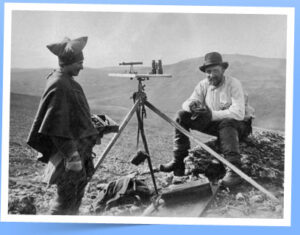
The strategies put to use in land surveying also have evolved over the centuries, over time. Long ago, people would use whatever could help them determine the distance from one point to another. This implies using chains with links and even ropes. Not surprisingly, this didn’t give accurate results but they did not have the technology we now have.

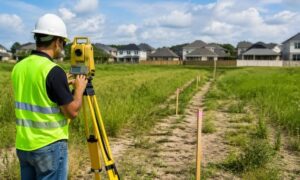
Today, land surveyors possess the best technologies to assist them with their job. There is GPS, or Global Positioning System, which is quite possibly the most accurate technologies available today. Total stations are also crucial to a land surveyor, which employs the utilization of an EDM or Electronic Distance Measurement device together with a theodolite which enables for further precise angle and distance measurements.

author avatar
Surveyor

More Posts

Aerial view of a modern highway corridor showing traffic flow, land development, and updated roadway design features in a growing region
civil engineering
Surveyor

Roadway Design Trends Driven by New Loop Projects

Texas grows fast, and road networks grow with it. Because of this growth, roadway design becomes a bigger priority for cities like Fort Worth. In the last few days, Texas started a major project in South Texas: a new 17-mile loop called Loop 195. The story spread across the state,

Read More »
A wide aerial view taken during drone surveying, showing tanks, pipelines, and complex structures across a large industrial site
land surveying
Surveyor

How AI Reality Capture Elevates Drone Surveying Data

Drone surveying has already changed how land data gets collected in places like Midland. It gives oilfield operators fast maps, clear images, and accurate measurements from above. Now another big shift is happening. New AI reality-capture technology—highlighted by a recent Looq AI expansion—is pushing the industry into a new era.

Read More »
A wooden backyard fence positioned near a property line survey marker, suggesting a boundary concern
boundary surveying
Surveyor

Can a property line survey prove who owns the fence?

If you’ve spent any time online lately, you’ve probably seen a viral story about two neighbors fighting over a backyard fence. One of them ordered a property line survey, and everything went downhill fast. The survey showed the fence wasn’t actually on the right boundary. The neighbor “went nuts,” and

Read More »
Red survey flags marking a corner point that helps define a boundary line survey
boundary surveying
Surveyor

How a Court Ruling Could Change Your Boundary Line Survey

If you follow land news, you probably saw the story about the “corner-crossing” case that reached the U.S. Supreme Court. It involved hunters, a private ranch, and a tiny survey corner that created a massive debate across the country. At first, it may seem far from Bryan, Texas, but it

Read More »
Civil engineer performing a dam inspection using a tablet near a hydraulic structure
civil engineering
Surveyor

Dam Inspection Proves Critical After Recent Failure

When news broke about a private dam failure, many homeowners across the state took notice. The Carter Lake dam developed a small 8-inch hole that quickly turned into a serious emergency. Evacuations were ordered, and engineers rushed to lower water levels before the earthen embankment gave way. It was a

Read More »
Aerial view of a new residential neighborhood designed through subdivision engineering, showing roads and uniform lot layouts under sunset light
civil engineering
Surveyor

The Subdivision Engineering Formula for Fast Approval

Getting a land development project approved can feel slow. One missing detail in your plans can set you back weeks. That’s where subdivision engineering makes all the difference. It’s the plan that turns open land into build-ready lots — and when it’s done right, your approval moves faster and smoother.

Read More »