How To Find Your Property On FEMA’s Flood Insurance Rate Maps

What are FEMA flood maps?
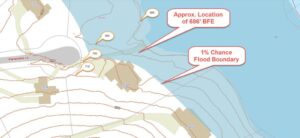
FEMA’s Flood Insurance Rate Maps (FIRMs) or just Flood Maps are provided after a flood risk assessment has been completed or updated for a community.  This study is known as a Flood Insurance Study.  The FIRM gives you the Base Flood Elevations (BFEs) and insurance risk zones in addition to floodplain boundaries.  The FIRM may also show a delineation of the regulatory floodway.

Once the “insurance risk zone”  (commonly referred to as the flood zone) is determined, actuarial rates, based on these risk zones, are then applied for newly constructed, substantially approved, and substantially damaged buildings.  FEMA uses these rates to determine the insurance rate you will pay for flood insurance

FEMA’s Digital Flood Maps

FEMA discontinued the production and distribution of paper flood maps in 2009 as part of its Digital Vision Initiative. This affected all the Flood Maps, boundary information, and study reports. However, clients can still view the products for free through their website or buy them in digital format.

To view these flood maps online, go to FEMA’s Map Service Center and key in your address (hi-lited area shown here) search for your home.  This will prompt you to then select the map that covers your area.  The Flood Maps are somewhat cumbersome to use online. It is best to go through the tutorial on the bottom right of the address search page for an easier and more effective use of the GIS map.

author avatar
Surveyor

More Posts

Licensed surveyor performing as built surveys at a completed commercial warehouse site to verify construction improvements
land surveying
Surveyor

How As Built Surveys Help Verify Commercial Site Improvements

Your warehouse is almost finished. The contractors are completing final work. Then you notice a problem. The building is 15 feet away from where the plans said it should be. The loading dock faces the wrong way. A water line is where you want to expand. This happens on many

Read More »
Surveyor assessing an irregular Hill Country property for a boundary survey cost estimate
boundary surveying
Surveyor

Why Boundary Survey Cost Can Increase on Irregular Lots

An irregular lot costs more to survey. This is important to know before you buy land or start building. Most developers think surveying costs match acreage. Not always. A 5-acre square lot might cost less than a 3-acre lot shaped like a flag. The shape matters more than the size.

Read More »
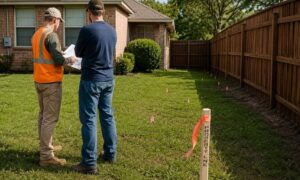
Homeowner and land surveyor reviewing property boundary markers and planned fence placement in a residential backyard before installation
boundary surveying
Surveyor

Do You Need a Property Survey Before Installing a Fence?

Building a fence sounds simple. Pick a style, hire a contractor, and start installation. But before any posts go into the ground, a property survey for fence installation can help homeowners avoid problems that often appear after work begins. In Bryan, Texas, where neighborhoods continue growing and property improvements are

Read More »
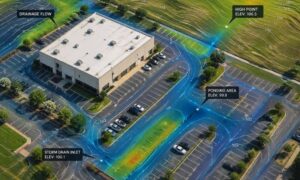
Aerial view of an office building with a blue and green drainage map overlay showing storm drains and elevation labels in the parking lot area.
land surveying
Surveyor

How LiDAR Mapping Helps Document Drainage Conditions 

Houston property owners are starting to run into a new kind of problem. It’s not always about building something new. Instead, it often comes down to proving what already exists on the property. Recent stormwater discussions around the Houston area show how things are changing. Fees and reviews now depend

Read More »
Aerial view of cars moving through a busy intersection showing traffic flow and turning patterns at a signalized crossing
civil engineering
Surveyor

Why Early Transportation Engineering Prevents Project Delays 

Fort Worth keeps growing. New stores, new offices, new neighborhoods show up every year. That sounds like progress, and it is. But behind every new project, there’s one thing that often gets ignored at the start: how people will actually get in and out. That’s where transportation engineering comes in.

Read More »