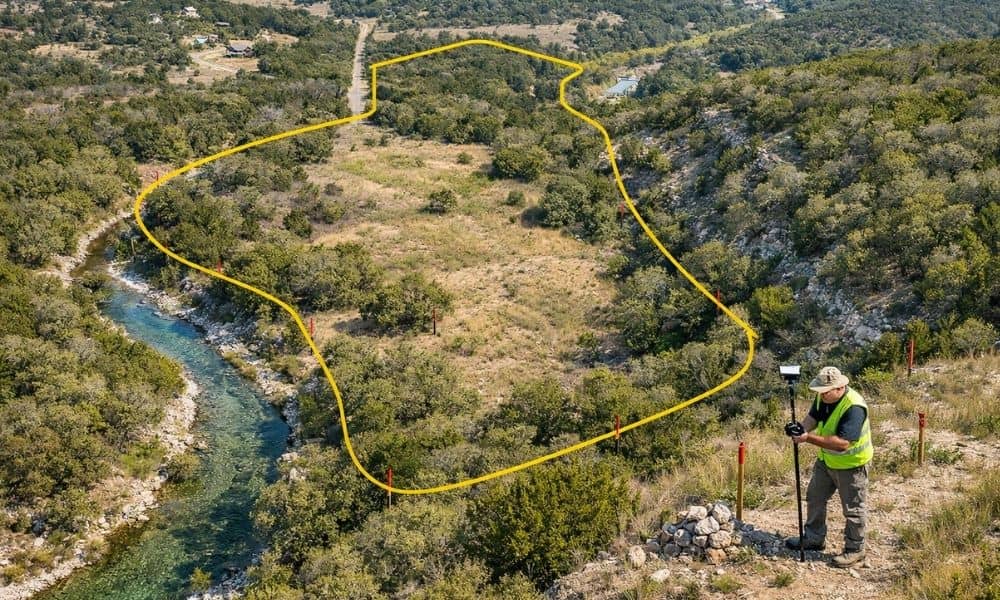
An irregular lot costs more to survey. This is important to know before you buy land or start building.
Most developers think surveying costs match acreage. Not always. A 5-acre square lot might cost less than a 3-acre lot shaped like a flag. The shape matters more than the size.
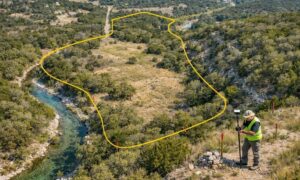
Hill Country properties have odd-shaped parcels. Ranch land has unusual divisions. Older properties have strange layouts. Curves, steep hills, and old descriptions all add cost to your boundary survey cost.
Let’s look at what makes these surveys expensive.
Why Hill Country Tracts Rarely Follow Simple Geometric Shapes
Ranch land in Hill Country does not follow straight lines. Properties are pie-shaped. Some look like flags. Others have strange angles.
Why? Creeks define some boundaries. Winding roads define others. Hillsides cut across more. These natural features create odd shapes.
Each odd shape needs extra work. Surveyors must check more angles. They must do more math. They must verify more measurements.
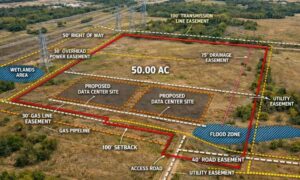
A square lot needs four markers and four angles. An odd-shaped lot might need eight markers and twelve angles. More markers mean more time. More time means higher cost.
Curved Boundaries and Meandering Features Can Require Additional Analysis
Straight lines are easy. Curved lines are hard.
Many Hill Country properties have curved boundaries. They follow roads, creeks, or old fences. These curves rarely go straight. A creek bends. A road curves. A fence twists.
The old deeds say “follow the creek.” But where is the creek now? Did it move? Did it flood? This is confusing.
Surveyors must dig into old records. They compare old maps with new maps. They check nearby properties. They look for old markers on the ground. They compare everything to make sure it all makes sense.
A curved boundary needs more research. It needs more field work. It needs more office work. All of this adds cost.
What Surveyors Look For on Curved Boundaries
Surveyors check many things:
- Old deeds that describe curves and angles
- Old maps and photos of the boundary
- Records of nearby properties
- Physical evidence like old fence posts or markers
- Changes over time, like road widening or creek movement
Elevation Changes Can Limit Visibility Between Boundary Monuments
Hill Country has steep hills. It has rock outcrops. It has thick woods. These things block the surveyor’s view.
Surveyors need to see from one marker to the next. On flat land, this is easy. On steep land, it is hard.
Hills block the view. Trees block the view. Ridges block the view.
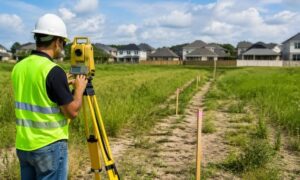
The survey crew must move equipment many times. They set up on high ground. Then they set up on low ground. Then they set up in between. Each move takes time.
Thick trees make it worse. Surveyors cannot see the markers. They must search the ground. They must clear branches. This takes extra time.
How Steep Terrain Affects Your Timeline
Rough ground usually adds:
- One to three extra days of work on site
- More time in the office doing math
- More workers needed
- More equipment needed
Older Ranch Divisions Often Create Gaps Between Record Descriptions and Physical Evidence
Old properties have problems. The old deed says “where the fence meets the creek.” But the fence is gone. The creek moved. The description does not match the land.
These gaps need investigation. Surveyors must become detectives.
They read old deeds. They read new deeds. They check nearby deeds. They search for old markers. They interview neighbors. They dig through county records.
Sometimes deeds conflict. One deed says one thing. Another deed says something else. Which one is right? This takes time to figure out.
Common Issues in Older Parcels
Historic properties often have:
- Descriptions of landmarks that no longer exist
- Different descriptions on neighboring properties
- Missing or destroyed markers
- Vague directions based on natural features
- Conflicting measurements from different years
Access Challenges on Irregular Lots Can Affect Field Efficiency
Bad shapes mean bad access. Flag-shaped lots have long, narrow strips. Some lots are divided by ravines. Some are split by creeks.
These conditions slow down work.
A square lot is easy. The crew sets up in the middle. They can see all four corners. Done.
A flag lot is different. The strip is long and narrow. The crew sets up at the strip. Then they move to the main part. Then they move again. Each move wastes time.
Dense brush makes it worse. The crew cannot drive through. They must hike. They carry equipment by hand. This is slow.
Weather matters too. A summer survey might be fast. A winter survey on the same lot might be slow. Rain makes creeks rise. Snow makes hills slippery. Mud slows equipment.
What Increases Your Bottom Line
Irregular lots cost more because:
- More time in the field
- More time in the office
- More research on old documents
- More math and calculations
- More equipment setups
- More problem-solving
Know these facts. Budget accordingly. Choose your surveyor wisely.
Frequently Asked Questions
Why does an irregular lot increase boundary survey cost?
Odd-shaped lots need more measurements. They need more research. They need more math. All of this takes time and costs money.
Do curved property lines affect the cost of a boundary survey?
Yes. Curves are hard to measure. They need extra checking. They need extra research. This costs more.
Can steep Hill Country terrain make a survey more expensive?
Yes. Hills block the view. Trees block the view. Rocks get in the way. The crew must move many times. This takes longer and costs more.
Why do older ranch properties sometimes require more survey work?
Old properties have old descriptions. Landmarks are gone. Records conflict. Surveyors must do detective work. This takes lots of time.
Are flag lots more expensive to survey?
Yes. Flag lots have long strips. They have odd shapes. The crew must work harder to reach all corners. This costs more money.