How To Find Your Property On FEMA’s Flood Insurance Rate Maps

What are FEMA flood maps?
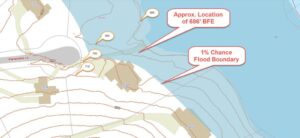
FEMA’s Flood Insurance Rate Maps (FIRMs) or just Flood Maps are provided after a flood risk assessment has been completed or updated for a community.  This study is known as a Flood Insurance Study.  The FIRM gives you the Base Flood Elevations (BFEs) and insurance risk zones in addition to floodplain boundaries.  The FIRM may also show a delineation of the regulatory floodway.

Once the “insurance risk zone”  (commonly referred to as the flood zone) is determined, actuarial rates, based on these risk zones, are then applied for newly constructed, substantially approved, and substantially damaged buildings.  FEMA uses these rates to determine the insurance rate you will pay for flood insurance

FEMA’s Digital Flood Maps

FEMA discontinued the production and distribution of paper flood maps in 2009 as part of its Digital Vision Initiative. This affected all the Flood Maps, boundary information, and study reports. However, clients can still view the products for free through their website or buy them in digital format.

To view these flood maps online, go to FEMA’s Map Service Center and key in your address (hi-lited area shown here) search for your home.  This will prompt you to then select the map that covers your area.  The Flood Maps are somewhat cumbersome to use online. It is best to go through the tutorial on the bottom right of the address search page for an easier and more effective use of the GIS map.

author avatar
Surveyor

More Posts

Professional land surveyor using GNSS GPS equipment to inspect a residential property near a utility easement and survey markers
land surveying
Surveyor

Why Survey Companies Near Me Ask About Easements Early

Most people expect the first call with a surveyor to be about property lines. It usually isn’t. Ask around, and you’ll hear the same story from homeowners, builders, and even real estate agents. The surveyor asks about easements before anything else. Not fences. Not corners. Easements. If you’ve searched for

Read More »
Aerial view of a large ranch with LiDAR mapping showing terrain elevations, drainage patterns, and water features across the property
land surveying
Surveyor

LiDAR Mapping Benefits for Ranches and Large Acreage Properties

A 2,000-acre ranch does not give up its secrets easily. Cedar breaks hide old fence lines. Draws and low spots flood without warning. Nobody has walked the back forty since the last drought. That is the reality for most large landowners in Texas, and it is exactly the kind of

Read More »
A land surveyor discusses property boundaries with a multigenerational family during a property survey update on their rural land
boundary surveying
Surveyor

How Property Survey Updates Can Simplify Family Land Transfers

Land that stays in one family for generations carries more than memories. It often carries paperwork problems too. Across San Antonio and Bexar County, many properties have belonged to the same family for thirty, forty, even fifty years. Somewhere along the way, the original survey got lost. Or it never

Read More »
Land surveyors from surveying companies mapping a future data center site
land surveying
Surveyor

Why Surveying Companies Are Seeing More Demand From Data Centers

Land near Austin is changing hands fast. Big companies want it for data centers. These buildings need power, water, and room to grow. That is pushing new work toward surveying companies, and the shift is bigger than most developers realize. Austin’s Data Center Corridor: Why the Land Rush Moved East

Read More »
Licensed land surveyor reviewing conflicting deed descriptions and survey maps while verifying a property boundary monument
land surveyor
Surveyor

How a Licensed Land Surveyor Handles Conflicting Deed Descriptions

When two deeds describe the same piece of land differently, a licensed land surveyor does not just pick the one that looks right. They follow a set order of evidence, built into surveying law, to figure out which description holds up. Often, this means going back through old county records

Read More »
Surveyor mapping existing underground utilities near a roadway construction site to help builders plan around utility conflicts
land surveying
Surveyor

Survey Mapping Helps Builders Plan Around Existing Utilities

Texas keeps growing. Highways are widening. Toll roads are stretching farther out. Rail lines and pipeline corridors are pushing into areas that used to be open land. All of this means one thing for builders: more utility relocations, and more surprises hiding underground. Old records don’t always show where a

Read More »